
Why Your AI Pilot Failed and Your Competitor's Didn't
Why Your AI Pilot Failed and Your Competitor's Didn't
Your competitor just automated their entire client onboarding process. You're still stuck in month six of an AI pilot that's going nowhere.
Same technology. Same budget. Completely different outcomes.
Here's what nobody wants to admit: the difference has nothing to do with the AI.
The $547 Billion Leadership Problem Disguised as a Technology Problem
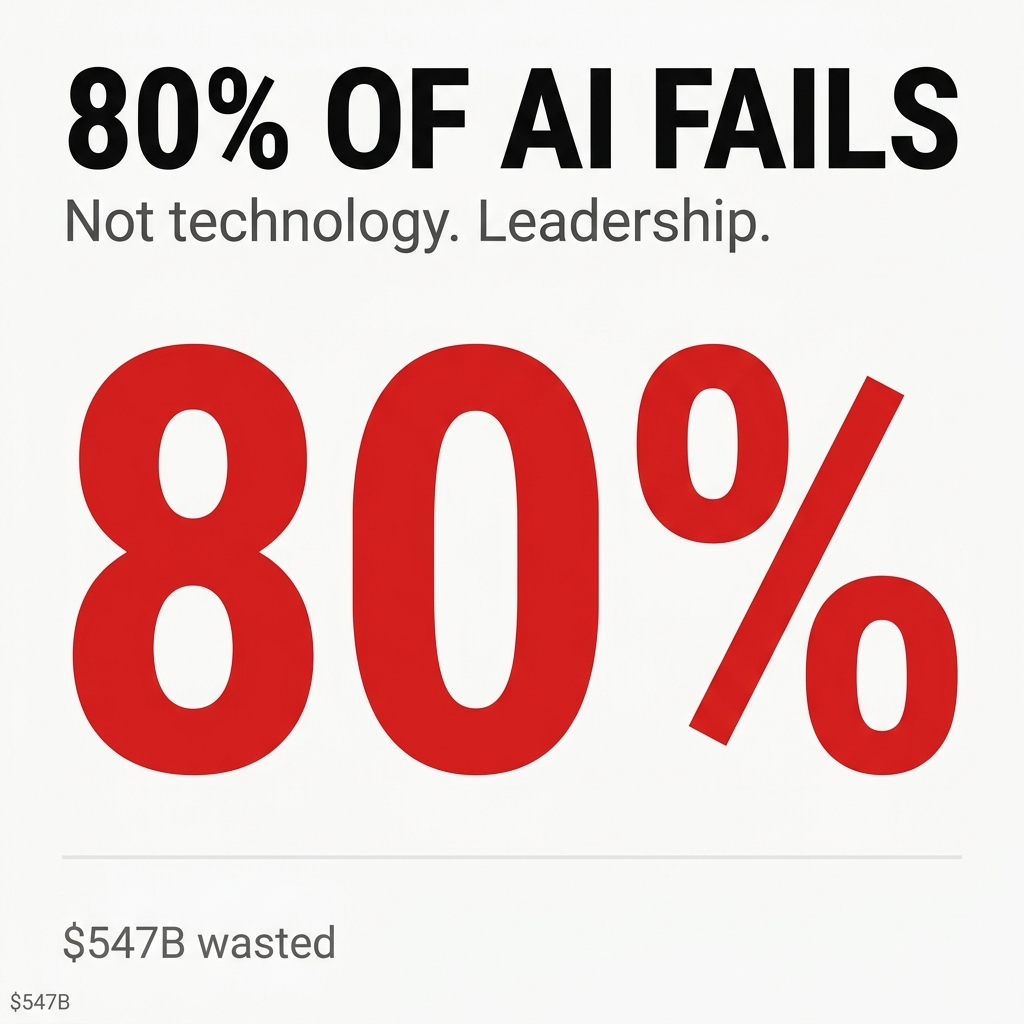
In 2025, global enterprises invested $684 billion in AI initiatives. Over $547 billion of that investment failed to deliver intended business value.
That's an 80% failure rate.
MIT research reveals that 95% of GenAI pilots fail to scale to production deployment. The median time from pilot approval to production shutdown? Just 14 months.
The most damning statistic: 73% of failed AI projects had no agreed definition of success before the project started.
You're not failing because the technology isn't ready. You're failing because you never defined what success looks like.
The Champion Problem Nobody Talks About
Most executives think AI needs executive buy-in or a steering committee.
Wrong.
What you actually need is a single person who owns the AI strategy. Not oversees it. Not sponsors it. Owns it.
When there's no champion, "shared responsibility" creates organizational paralysis. Everyone assumes someone else is watching. Problems go unaddressed. Model performance degrades without intervention.
McKinsey found that AI high performers are three times more likely than peers to strongly agree that senior leaders demonstrate ownership of and commitment to AI initiatives.
Yet 56% of AI projects lose C-suite sponsorship within six months.
Your leadership team is busy running the business the way they currently run it. AI is such an important technological change that you need someone with actual time to understand the gaps, assess what's out there, and focus on delivering solutions.
Without that champion, you get shiny object syndrome. Teams jump into tools that don't move the needle while missing massive transformation opportunities.
The Manual-First Paradox That Saves Months of Trial and Error
Here's where most companies get it backwards.
They throw AI at the problem first and hope it figures things out.
The companies that succeed do the opposite. They do the process manually first to establish what excellent looks like, then hand that specification to the AI.
Take automated client audit reports. Seems simple, right? Gather data, generate a report, send it to the sales team.
When you actually build it, you discover complexity you didn't anticipate. How much autonomy does the agent have in determining what information to include? How do you ensure the data collected is provable and accurate? What guard rails prevent the agent from making recommendations you haven't approved?
The solution: Design the manual report first.
Define the key KPIs. Specify what data to collect. Establish the conditional logic for scoring. Create the framework. Then allow the agent to do the data collection, collate it into one file, and generate the branded report using your approved layout.
Set all the parameters and guard rails first. Give that to the agentic AI. Test it robustly. Only then deploy it.
If you give AI what excellent looks like, it understands that and can adopt it. You get standardized outputs you're happy with.
Otherwise you spend months running back and forth, trying to work out with AI what excellent looks like. It takes an awful long time. It's frustrating.
This is specification-driven development, and it's making a comeback. GitHub's AI team now promotes it as the workflow where specs become the shared source of truth—living, executable artifacts that evolve with the project.
You create a skill and save it. Once you've got a skill saved, your outputs are consistent every time.
Stop Relying on AI for Everything
This might sound strange coming from someone building AI solutions, but here's the truth: companies failing with AI are the ones who've abdicated their thinking to the technology instead of using it as a tool.
A lot of staff now rely heavily on AI to do their thinking for them. That's a mistake.
Critical thinking is a top-level human skill. While AIs have effectively very high IQs across every subject you can think of, you still need human input and critical thinking skills to adopt these correctly and structure them properly.
That saves time and money.
Once you've taught AI, automations are fantastic and will save you lots of time and money. But in setting them up, human input is still required. You can't currently rely on AI to do everything for you.
Look at your current systems. How do you manage things at the moment? What documentation do you use? What data do you collect?
Improve that. Create a manual version of that before you give it to AI.
It might be old school, but it saves an awful lot of time if you put that effort in prior to engaging the AI and creating the automations.
The Data Quality Problem Just Got Exponentially Worse
Traditional software fails predictably with bad data. You get error messages. Null values. Reports that don't run.
Agentic AI fails differently.
It doesn't stop. It doesn't throw errors. It makes decisions based on whatever information is available.
Garbage in, exponentially compounded garbage out.
While 85% of failed AI projects cite poor data quality as a root cause, only 12% of organizations have data of sufficient quality to support AI applications.
Gartner predicts that 60% of AI projects lacking AI-ready data will be abandoned through 2026.
The critical insight: agentic systems don't just fail with bad data. They amplify existing data problems because autonomous agents make decisions on available information.
Traditional data management runs at quarterly audits and monthly pipeline checks. AI models in production need data quality signals measured in hours.
That mismatch is where most data quality AI problems originate.
The Autonomy Paradox You're Not Addressing
Here's the architectural tension nobody wants to talk about.
Freely acting agents maximize flexibility but introduce unpredictability. Constrained workflows sacrifice adaptability for consistency.
You need to consciously navigate this spectrum. There's no default answer.
When you build automated audit reports, you face this exact trade-off. The agent needs freedom to gather information independently. But you also need guard rails to ensure the data collected is provable and accurate.
What seemed like a simple job turns into a more complex job that takes longer than expected.
The solution isn't choosing between autonomy and control. It's defining exactly where you draw the line for each specific use case.
What does the agent decide? What do you constrain?
Organizations pursuing sophisticated agentic implementations report that 66.4% use multi-agent system designs rather than single-agent approaches. That reflects the complexity of enterprise workflows.
But complexity without clarity creates chaos.
The SME Advantage in AI Implementation
Here's the good news if you're running a small or mid-sized business.
You can avoid the governance dysfunction, accountability gaps, and pilot proliferation that plague enterprises.
Large enterprises abandoned an average of 2.3 AI initiatives in 2025, with $7.2 million average sunk cost per abandoned project. Mid-market firms abandoned 1.1 initiatives on average.
The pattern is clear: smaller organizations can get this right from day one.
You don't have layers of bureaucracy. You don't have competing steering committees. You don't have eight to twelve pilots running simultaneously with no clear exit criteria.
You can assign one champion. Define success upfront. Invest in data foundation first. Treat deployment as organizational change, not software launch.
The successful 19.7% of AI implementations share three things: they defined success upfront, invested in data foundation first, and treated deployment as organizational change.
You have the structural advantage to do all three.
What Good Champions Actually Do
A good champion focuses on understanding the challenges and what will move the needle the most for the company.
What are the areas where AI adoption makes sense? What's the low-hanging fruit that would move the needle the most for your particular business in terms of automations and AI adoption?
But they also take into account security, data protection, and correct usage of AI within the business.
The market is changing so rapidly that you need somebody focused on that and focused on delivering solutions. Either you assign that role internally, or you bring in a company that will do it with you.
Even when you bring in outside help, you still need a champion in the business who can translate information and deliver it to the leadership team so they understand what's important and what's not.
Leadership teams need to be involved. They're going to be busy. You don't need a steering committee.
You need one person who owns outcomes.
The Security Blindspot in Your Agentic Strategy
Traditional perimeter security assumes humans initiate all consequential actions.
Agentic systems collapse that assumption.
When AI agents access sensitive systems autonomously, they create novel attack surfaces. You need zero-trust architectures that treat internal agents as potential threats.
The governance challenge extends beyond technical security. Nearly 80% of organizations deploy AI without a defined governance owner or operating model.
When failures occur, the pattern is consistent: the failure is almost never the model. It's data readiness, workflow integration, and the absence of a defined outcome before build starts.
Executives must assume responsibility for technologies deployed, even if technical details remain unclear.
You need specific owners for specific outcomes before deployment. Not after problems appear.
Human Accountability as Non-Negotiable Design
Here's the final piece that separates successful AI adoption from expensive failures.
Human accountability must be built into the design, not bolted on after deployment.
When you delegate judgment to machines without human oversight, you create ethical and practical risks. Especially in customer-facing applications like voice agents.
The organizations succeeding with AI understand this. They assign clear decision rights defining who reviews outputs, who can override them, and who is accountable when something goes wrong.
When AI governance is weak, even technically sound systems create significant operational, legal, and reputational risk.
You need human input and critical thinking skills to adopt AI correctly and structure it properly.
Once you've taught AI, automations are fantastic. But in setting them up, human input is still required.
You can't currently rely on AI to do everything for you.
What This Means for Your Next AI Initiative
Your competitor isn't succeeding because they have better technology.
They're succeeding because they assigned a champion who owns outcomes. They defined what excellent looks like before handing anything to AI. They invested in data quality as a foundation, not an afterthought. They built human accountability into the design from day one.
You can do the same thing.
Start by looking at your current systems. How do you manage things now? What documentation do you use? What data do you collect?
Improve that. Create a manual version. Define the parameters and guard rails. Then give that specification to AI.
Assign one person to own the strategy. Give them actual time to understand gaps and assess what's out there. Let them focus on delivering solutions instead of juggling AI as a side project.
Define success before you start. Not what you hope might happen. What specific, measurable outcome makes this project worth doing.
Treat deployment as organizational change, not software launch. Your people need to understand what's changing, why it matters, and how their work will be different.
The technology is ready. The question is whether your organization is ready to use it correctly.
That's not a technology question. That's a leadership question.
And leadership questions require human answers.
