AI Is Replacing Jobs But Small Businesses Can Win
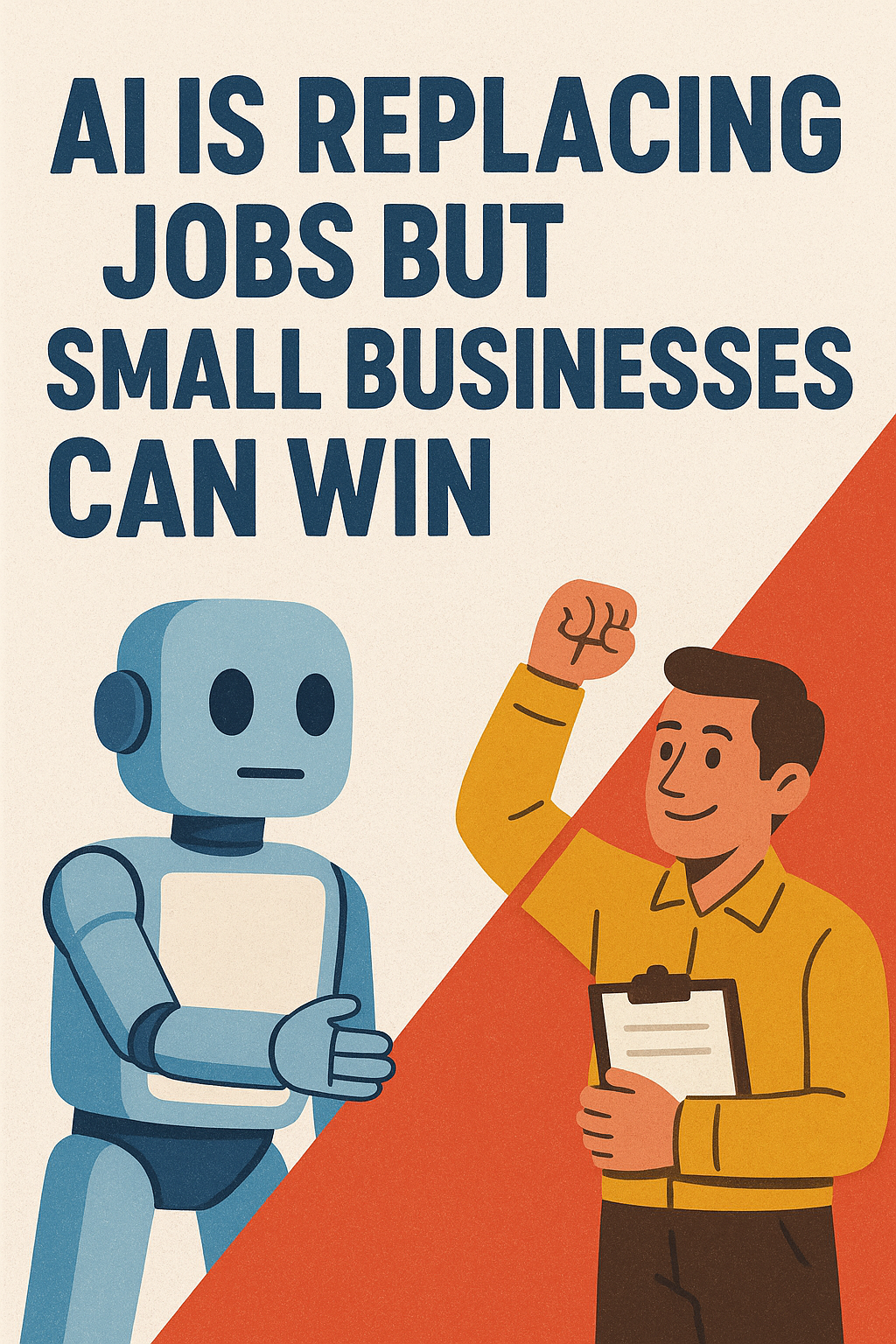
AI Is Replacing Jobs But Small Businesses Can Win
The numbers are stark: over 76,000 jobs lost to AI this year alone. But what if that's only half the story?
We're witnessing a fundamental shift in how work happens. AI is eliminating positions faster than many predicted, with 513 people losing their jobs to automation every single day in 2025.
The fear is real. And justified.
Yet something curious is happening in the small business sector that deserves our attention.
The Great AI Pullback
While enterprise companies race to implement AI, small businesses are actually retreating. A recent survey shows small business AI adoption dropped from 42% in 2024 to just 28% in 2025.
This pullback comes precisely when AI tools are becoming more powerful and accessible than ever before.
Why the disconnect?
The answer isn't technological – it's psychological and practical. Small business owners cite three primary concerns: cost, complexity, and business risk. Many still view AI tools as too complicated or meant only for larger enterprises with dedicated IT departments.
This perception creates both a challenge and an opportunity.
The Hidden Advantage for Small Businesses
Large corporations are using AI primarily to reduce headcount and cut costs. But small businesses have a different opportunity altogether.
For the SME sector, AI isn't about replacing people – it's about amplifying them.
Think about the typical small business owner. They wear multiple hats, juggle countless tasks, and constantly face the limitation of having just 24 hours in a day. Their primary constraint isn't workforce size but time and attention.
This is where properly implemented AI creates an asymmetric advantage.
While enterprises use AI to eliminate jobs, small businesses can use the same technology to eliminate constraints.
The Implementation Gap
The challenge isn't whether AI works – it's getting it to work for you.
According to BCG research, 74% of companies struggle to achieve and scale value from AI. Without decisive action, businesses risk falling significantly behind those who figure it out.
The key insight from this research? Successful AI transformations need to focus two-thirds of effort on people-related capabilities, not just technology.
This explains why so many small businesses try AI tools but abandon them. They encounter systems designed by engineers for engineers – not for busy entrepreneurs with limited technical resources.
What's needed isn't more AI features but better AI implementation.
Bridging the AI Divide
At Ascendea, we've seen this pattern repeatedly. Small businesses want the benefits of AI but not the complexity that typically comes with it.
The solution isn't dumbing down the technology. It's smartening up the interface.
We believe the next wave of AI adoption will be led by platforms that combine enterprise-grade capabilities with consumer-grade usability. Systems that work intuitively from day one, without requiring a technical degree or dedicated staff to manage.
This approach aligns with our core mission: empowering small and medium-sized businesses to grow faster, serve smarter, and scale sustainably using AI.
The Practical Path Forward
For small business owners wondering how to approach AI in this environment, we recommend three principles:
Start with specific problems, not general capabilities. Identify your most time-consuming repetitive tasks and focus AI implementation there first.
Prioritize integration over innovation. The most valuable AI tools connect seamlessly with your existing systems rather than requiring you to rebuild workflows from scratch.
Value simplicity over features. An AI solution you can actually use is infinitely more valuable than one with impressive capabilities that sits unused.
The businesses gaining competitive advantage aren't necessarily using the most advanced AI. They're using appropriate AI appropriately.
Beyond the Fear Narrative
Yes, AI is eliminating certain jobs. This trend will likely accelerate before it stabilizes.
But for small businesses, this technological shift represents something different than it does for large enterprises. It's not primarily about workforce reduction – it's about capability expansion.
AI allows small teams to deliver services at a scale and quality level previously possible only for much larger organizations. It enables entrepreneurs to focus on the creative and strategic work that machines can't replicate.
The key is finding the right balance between human ingenuity and artificial intelligence.
The Small Business AI Advantage
While headlines focus on job displacement, we're seeing a parallel story unfold: small businesses using AI to level the playing field against larger competitors.
By automating routine tasks, enhancing customer service with AI voice agents, and deploying predictive marketing, SMEs can now deliver experiences that match or exceed those of much larger companies.
This capability was simply unavailable to small businesses even five years ago.
The most successful adopters understand that AI isn't a replacement for business strategy – it's an amplifier for it. They start with clear objectives, then apply AI selectively to achieve them.
Moving Forward Together
The AI revolution is neither as apocalyptic nor as utopian as extreme voices suggest. Like all technological shifts, its impact depends largely on how we choose to implement it.
For small businesses, the path forward isn't about resisting AI or surrendering to it. It's about harnessing it strategically to enhance what makes your business special while automating what doesn't.
The businesses that thrive won't be those with the most advanced AI. They'll be those who most thoughtfully integrate AI into their unique value proposition.
In this environment, small can be not just competitive, but advantaged. Nimble businesses can adapt faster, implement more precisely, and create more personalized experiences than their larger counterparts.
The AI future belongs to those who see beyond the fear and recognize the opportunity.
It belongs to those who understand that in the right hands, AI doesn't replace human potential.
It unleashes it.
